Discover the largest telescopes in the world
Astronomers worldwide rejoice with every new telescope put into service, which is often larger than the previous one.
Between 1948 and 2019, no fewer than 29 large telescopes were put into service worldwide.
The world's largest mirror, dating back to 1977, has a diameter of 5 meters. It will be surpassed in 2024 by the ELT (Extremely Large Telescope) which will have a 39-meter diameter mirror and will be installed in Chile. Thanks to technological advancements and the discovery of new manufacturing methods, it will become the world's largest telescope.

Telescopes for observing the sky
Telescopes only flourish at high altitudes, generally above 4,000 meters, to escape atmospheric disturbances and thus obtain maximum visibility and sky study time.
The most suitable areas in the world are mainly located in the Chilean Andes and the Pacific Ocean.
In this article, I will introduce you to the 19 largest telescopes in the modern world with numerous photos and a summary of their history and the greatest discoveries they have enabled.

Bags, Mugs, artwork, mousepads... The NASA collection awaits you!
Discover NASA Accessories →
The Giant Magellan Telescope
The Giant Magellan Telescope, abbreviated "GMT," is part of the American program for large telescopes. Its construction is located at the Las Campanas Observatory in Chile.

The Giant Magellan Telescope - Source: Official Website https://www.gmto.org/ - All rights reserved
This giant is scheduled to begin operations in 2023 and will consist of seven mirrors, each 8.4 meters in diameter, with a total optical surface area of 24.5 meters in diameter and a collecting area reaching 368 m2.
The collecting surface is what will allow the capture of maximum light; the larger the mirror's diameter, the more light and, consequently, more detail the collecting surface will capture.
Discover the construction of this giant telescope in video.
For comparison, its resolution will be 10 times greater than that of the Hubble Space Telescope, which is simply incredible. This is a true technological feat, and a goldmine of information and exploration for astronomers.
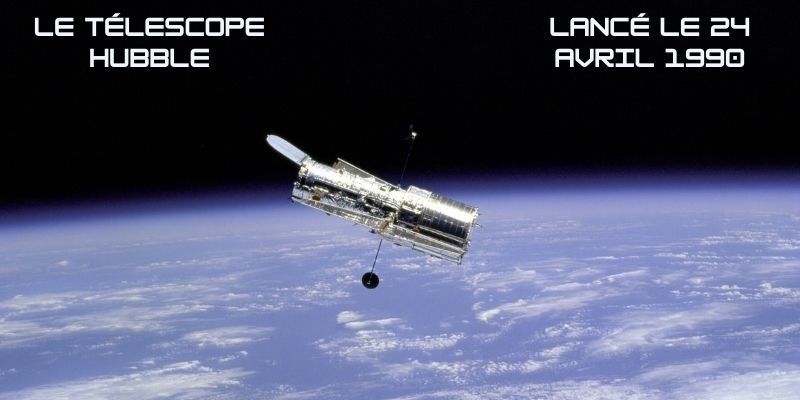
HUBBLE SPACE TELESCOPE developed by NASA with participation from the European Space Agency - All rights reserved

The NASA collection is here! Choose your cap and take off.
Discover NASA Headwear →
The Southern African Large Telescope (SALT)
This telescope is located at the South African Astronomical Observatory (SAAO) near the small town of Sutherland, in the Northern Cape province, about 400 km from Cape Town.
SALT is currently funded by a consortium of international partners from South Africa, the United States, Poland, India, and the United Kingdom. The telescope has been in full scientific operation since 2011 and is realizing its enormous potential as Africa's giant eye on the Universe.

Giant "SALT" Telescope - Source: Official Website https://www.salt.ac.za/galleries/photo-gallery/ - All rights reserved
This large Southern African telescope is the largest optical telescope in the Southern Hemisphere.
It has a hexagonal primary mirror 11.1 meters in diameter composed of 91 hexagonal segments, each one meter, that scans the universe with its "Giant Eye."

Shot by SALT: Lagoongreen - Image Source: https://www.salt.ac.za - All rights reserved
Only the secondary mirror of this telescope can move to allow tracking of an object in the celestial sphere.
The W. M. Keck Observatory
From Maunakea in Hawaii, astronomers worldwide use the W. M. Keck Observatory to observe the universe with unprecedented power and precision.

The W. M. Keck Observatory on the island of Hawaii - Source: Website https://keckobservatory.org/ - All rights reserved
The island of Hawaii is surrounded by thousands of miles of thermally stable seas. The 4,207-meter summit of Mauna Kea has no nearby mountain ranges to disturb the high atmosphere. Few city lights pollute Hawaii's night sky, and for most of the year, the atmosphere above Mauna Kea is clear, calm, and dry, offering the best view on Earth.
The W. M. Keck Observatory is one of many observatories located at the summit of Mauna Kea, which stands at an altitude of 4,145 meters on the island of Hawaii, located in the center of the Pacific Ocean.
This observatory is primarily funded by the foundation of billionaire William Myron Keck.
The Keck I and Keck II telescopes were commissioned in 1993 and 1996, respectively. Their primary mirrors each measure 9.8 meters in diameter and consist of 36 hexagonal segments. They are currently the most productive optical and infrared telescopes in the world.
Each telescope weighs 300 tons and operates with nanometer precision, working in concert like a single piece of reflective glass.
The Gran Telescopio Canarias (GTC)
The "Gran Telescopio CANARIAS" (GTC) is located in one of the best astronomical sites in the Northern Hemisphere.
It is installed at the Roque de los Muchachos Observatory "ORM", La Palma in the Canary Islands at an altitude of 2,400 meters, and it is one of the best observation sites in the Northern Hemisphere. Its primary mirror measures 10.4 meters in diameter, and its resolution is close to that of the Hubble Space Telescope.
It is a telescope equipped with a segmented primary mirror.

The giant GTC telescope of the Canary Islands - Source: Official Website http://www.gtc.iac.es/ - All rights reserved
The GTC is a Spanish initiative led by the Instituto de Astrofísica de Canarias "IAC".
The project is actively supported by the Spanish and local governments of the Canary Islands through the European Regional Development Funds "ERDF" provided by the European Union.
The project also includes the participation of Mexico's "Instituto de Astronomía de la Universidad Nacional Autónoma de México" (IA-UNAM), "Instituto Nacional de Astrofísica, Óptica y Electrónica" (INAOE) and the American University of Florida.

Photo taken by the giant GTC telescope of the Canary Islands - Source: Website http://www.gtc.iac.es/multimedia/ - All rights reserved
It is sometimes nicknamed "GranTeCan" for Gran Telescopio Canarias.
The European Extremely Large Telescope (ELT)
Formerly E-ELT, for European Extremely Large Telescope, the ESO's ELT (Extremely Large Telescope) is expected to see its first light in September 2027 following delays due to the COVID-19 epidemic which forced the site to close in mid-2020.

European Extremely Large Telescope "ELT" - Source: Official Website https://elt.eso.org/media/
Credit: ESO - All rights reserved
Currently under construction at the summit of Cerro Amazones (3,046 meters altitude), a mountain neighboring Cerro Paranal where the VLT (Very Large Telescope) is installed, the ELT will be the world's largest optical telescope, collecting more light than all existing 8-10 meter class telescopes on the planet combined.
Despite its 2,800 tons, the structure that will support the whole will allow pointing with an accuracy of 1 arcsecond.
But what is an arcsecond?
A degree of arc of an angle is 1/360th of the circumference of a circle. An arcminute is 1/60th of an arc degree, and finally an arcsecond is 1/60th of an arcminute. Everything is clear now 😳
To be clearer in my explanations, I will give you a more illustrative example.
Imagine you are aiming at the Moon!
Its diameter is about half an arc degree or 30 arcminutes. If you do the same with Jupiter, its diameter will be much smaller because it is further away: 40 to 45 arcseconds. It would take 60 arcseconds for its diameter to be equal to one arcminute.
This way, we can measure, for example, the diameter of the Moon's craters or the apparent distance between stars.
For those who still don't understand what an arcsecond is, here's a video by Florence Porcel that makes the connection between the parsec and an arcsecond.
▶︎ Link between parsec and arcsecond
To find out how long it takes to reach the moon, I invite you to read our article on this subject: How long to get to the Moon →
Telescope features
With its 39-meter diameter primary mirror, providing 1,116 m2 of collecting surface, this telescope will be the largest optical and near-infrared telescope in the world. No less than 798 mirrors, each 1.4 meters in diameter, will be assembled to form the primary mirror, and its five-mirror design, combined with advanced technology to correct atmospheric distortions, will be truly unique in the world!
It will provide images 15 times sharper than those from the Hubble Space Telescope.
ESO's ELT will be used to push scientific boundaries in areas such as the discovery of habitable exoplanets, galaxy formation, or the study of dark energy and matter.
ESO shot

Shot from the European giant "ELT" telescope - Source: site https://elt.eso.org/
Credit: ESO - All rights reserved
The TMT Telescope
The "Thirty Meter Telescope" is a Thirty Meter Telescope as its name suggests.

The project of the future giant TMT telescope - Source: site https://www.tmt.org/featured_images - All rights reserved
It is a giant telescope that belongs to the new generation of giants dominated by the ELT.
This telescope is expected to be built on Mauna Kea in Hawaii alongside existing older generation telescopes.
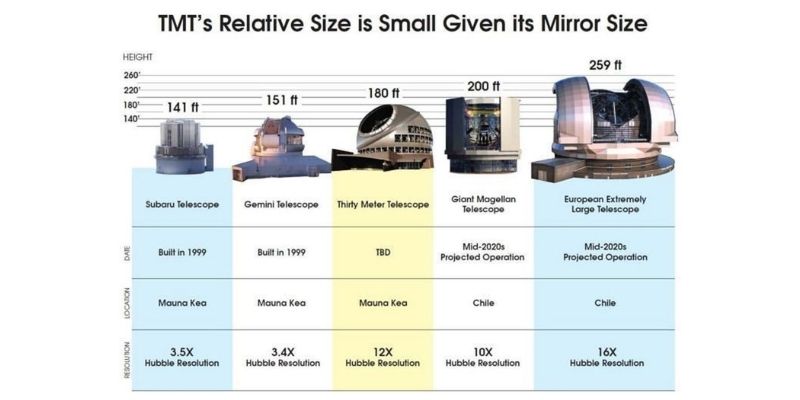
The size comparison of telescopes relative to the future giant TMT project - Source: site https://www.tmt.org/featured_images - All rights reserved
Its primary mirror will combine 492 segments, and its collective surface will be 10 times larger than that of its future Keck neighbors.
The Large Binocular Telescope (LBT)
The Large Binocular Telescope is located on Mount Graham in Arizona, at an altitude of 3,200 meters. It was first commissioned on October 26, 2005, when it received its first light.
Its unique feature is that it has two large eyes open to the cosmos, each 8.4 meters in diameter, placed side by side on the same mount.
This setup, combined with adaptive optics, allows for very high angular resolution, low thermal background, and exceptional sensitivity for detecting faint objects.

The LBT telescope - Source: https://old.aip.de/en/research/facilities/lbt - All rights reserved

Wear the universe on your feet with these exclusive NASA sneakers!
Discover NASA Sneakers →
The Very Large Telescope (VLT)
This is a very large telescope located at the summit of Cerro Paranal in Chile, at an altitude of 2,635 meters. It consists of four telescopes, each 8.2 meters in diameter:
- Antu,
- Kueyen,
- Melipal,
- Yepun.
Antu was the first to be commissioned and received its first light in 1998.
The four auxiliary telescopes, 1.8 meters in diameter, accompany the array. When they combine all their light, they become the VLTI, a giant interferometer.

Early morning on Paranal - Credit: ESO/H.H. Heyer - Source: https://www.eso.org/public/images/vlt-laser-potw/ - All rights reserved
Its acuity is then up to 25 times greater than that of a single telescope.
The Baade and Clay Telescopes
The two Magellan telescopes were built by the Carnegie Institution of Washington and a collaboration between:
- the Carnegie Institution,
- the University of Arizona,
- Harvard University,
- the University of Michigan
- and the Massachusetts Institute of Technology.
The Magellan consortium is composed of over 200 experienced astronomers, 100 postdoctoral astronomers, and nearly 100 doctoral students.

The Baade and Clay telescopes - Source: https://blogs.futura-sciences.com/feldmann/2015/04/27/en-video-laluminure-du-telescope-baade-en-accelere/
Photo by © Dave Jurasevich - All rights reserved
Each partner has its own scientific program for the telescopes and allocates its share of telescope usage.
They were built at the Las Campanas Observatory in Chile for the Magellan project and were named after:
The Walter Baade Telescope was the first of the two 6.5-meter Magellan telescopes to be completed in 2000, followed by the Landon T. Clay Telescope, completed in 2002.
Both telescopes are located 60 meters apart on an isolated peak (Cerro Manqui). The telescopes are of alt-azimuth design.
The Atacama Large Millimeter/submillimeter Array (ALMA)
"Alma" means "soul" in Spanish and is the acronym for "Atacama Large Millimeter/submillimeter Array."
It is a vast array of 66 antennas located on the Chajnantor plateau in Chile.
Amazing video about the Alma telescope array
The main array consists of 50 antennas, 12 meters in diameter, which form an interferometer.
A small array of 4 antennas, 12 meters in diameter, and 12 antennas, 7 meters in diameter, complements it.
Its resolution can be 10 times greater than that of the Hubble Space Telescope.
The Allen Telescope Array (ATA)
Formerly the One Hectare Telescope (1HT), the Allen Telescope Array (ATA) is a "Large Number of Small Dishes" (LNSD) array that serves astronomers and the SETI program.

Formerly One Hectare Telescope (1HT) - Source: Seti Institute - All rights reserved
Located at the Hat Creek Observatory in Lassen Volcanic National Park, northern California, it consists of 42 antennas, each 6.1 meters in diameter.
It will eventually have 350 antennas for a total collecting area of 10,000 square meters.
Paul Allen, the co-founder of Microsoft, is its main patron.
The Very Large Array (VLA)
The Karl G. Jansky Very Large Array, or more commonly the Very Large Array (VLA), is a set of 27 mobile parabolic antennas, each 25 meters in diameter, located in New Mexico, United States.
The antennas are arranged in a Y-shape along two axes. One is 21 km long, and the other is 19 km long.

Photo by Dave Finley, courtesy of the National Radio Astronomy Observatory and Associated Universities, Inc. - Source: https://www.researchgate.net - All rights reserved
Their combined data offer the resolution of a giant radio telescope 36 kilometers in diameter.
The Arecibo Telescope
With its 305-meter diameter, Arecibo was the world's largest radio telescope until 2016.
It was built in a depression. Its immobile antenna consisted of some 38,778 perforated aluminum panels. The receiver, suspended 150 meters above it, was mobile via 18 cables.

Arecibo Telescope Site: https://www.naic.edu/ao/landing
Source: https://www.naic.edu - All rights reserved
Arecibo began operations in 1963.
Damaged by Hurricane Maria in September 2017, then by the rupture of an auxiliary cable in August 2020, creating a gash about 30 meters long on the radio telescope's reflector dish, it finally collapsed on December 1, 2020, when cables broke at the top of one of the radio telescope's three towers.
The 900-ton receiver platform fell onto the reflector, 120 meters below.
This event caused great emotion within the scientific community and sparked a wave of support for its reconstruction, which is now being considered.
The Palomar Observatory
The private Palomar Observatory, north of San Diego, California, housed the world's largest telescope between 1949, its first operational date, and 1975.
The Hale Telescope, named after astronomer George Ellery Hale, with a 5.08-meter diameter, was the giant of the second half of the 20th century, through which astronomers made great cosmological discoveries.
Still active, it notably participates in the tracking of near-Earth asteroids since 2001.

Aerial view of Palomar Observatory. (Palomar/Caltech)
Observatory website: https://sites.astro.caltech.edu/palomar/homepage.html
Image source: https://sites.astro.caltech.edu/palomar/media/observatorymedia.html - All rights reserved
The VISTA Telescope
VISTA stands for "Visible and Infrared Survey Telescope for Astronomy."

Source: https://www.eso.org - All rights reserved
It was inaugurated in 2010. It is a 4.1-meter diameter telescope that surveys the sky in visible and infrared light in the shadow of the VLT giants, at the summit of Mount Paranal in Chile.
It is the largest of its kind and operates in one of the world's most beautiful observation sites.
The New Technology Telescope (NTT)
Inaugurated in 1989 at the La Silla Observatory in Chile, the New Technology Telescope (NTT) is the pioneer of the new generation of telescopes of the ESO, the European Southern Observatory.

Source: https://www.eso.org - All rights reserved
Its main mirror, 3.58 meters in diameter, is flexible and was the first to experiment with active optics.
Furthermore, it benefits from an innovation that would become a landmark, namely the installation of an octagonal dome with a ventilation system.

Get ready to explore the universe in style. Which bag is for you?
Choose my NASA Bag →
The "HARPS" Spectrograph
The La Silla Observatory houses a 3.6-meter diameter telescope that was one of the pioneers of large telescopes in Chile.

Photo origin: https://insider.si.edu - (INAF Photo) - All rights reserved
Official HARPS spectrograph site: https://www.eso.org/
Commissioned in 1977, it underwent a second youth in 1999.
Since April 2008, the HARPS spectrograph, which stands for "High Accuracy Radial velocity Planet Searcher," has been a powerful exoplanet hunter.
The "CFHT" Observatory
The CFHT, which stands for "Canada-France-Hawaii Telescope," began operations in 1979.

Image source: https://www.cfht.hawaii.edu - All rights reserved
It is located in Hawaii, alongside other large observatories that have flourished on the summit of Mauna Kea at an altitude of 4,200 meters since the late 1970s.
The Canada-France-Hawaii Observatory houses a telescope with a 3.58-meter diameter.
The Gemini Observatory
The Gemini Observatory is divided into two identical 8.1-meter diameter telescopes located at two of the world's best observation sites.
"Gemini North" is located in Hawaii in the Northern Hemisphere, and "Gemini South" is in Chile in the Southern Hemisphere.
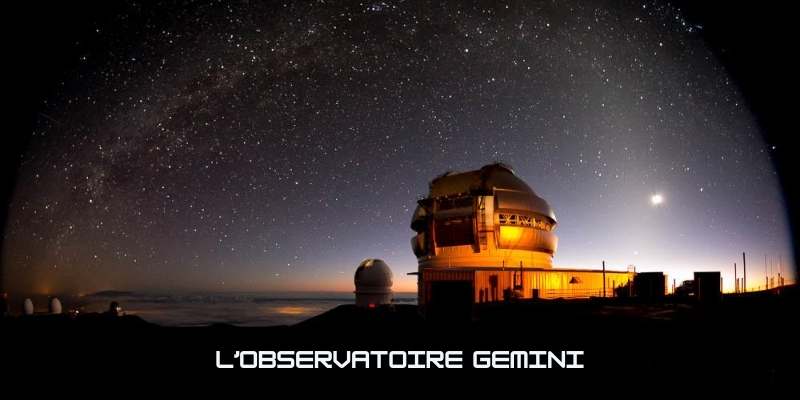
Gemini North under a Milky Way arc - Gemini Observatory/AURA image by Joy Pollard
Photo source: https://www.gemini.edu - All rights reserved
Their positions allow them to cover the entire celestial sphere.
Exploring the infinite, and more!
You've just taken a grand tour of the world's largest telescopes. Feel free to leave your comments and remarks on this article, which I tried to make comprehensive with numerous photos to illustrate my points and links to guide you to more information.
"Space exploration from Earth is exciting and full of surprises..."
Furthermore, telescopes not only play an exploratory role but also a monitoring role for potential objects that could hit Earth or the arrival of surprise guests...
Need a sidereal ambiance?
Our canvases and posters prepare you for your next mission… SHOPPING!
Space Canvases and Posters →
See you soon for a new article on infinity and beyond.
Louise from the NASA SHOP France Team