Discover the true History of the Sweatshirt! From its origins to the present day...
The history of the Sweatshirt
Creation of the Sweatshirt
The Sweatshirt was reportedly invented in 1926 by Benjamin Russell, head of the company he founded in Alabama, USA, in 1902: Russell Athletic Company.
This company was already specialized in textiles, specifically in the manufacture of underwear.

Benjamin Russell, founder of the Russell Athletic textile company (source: Russell Athletic)

Location of the state of Alabama on the USA map (source: Wikipedia)

Russell Athletic company logo (source: Russell Athletic)
The idea of inventing the Sweatshirt came to him from his own son, Benjamin Russell Junior, who was a Quarterback on a local Football team.
For your information, the Quarterback is the one who stands behind his players and who, during the game, receives the ball and throws it to his forwards to score. He is essentially the one who directs the offense.
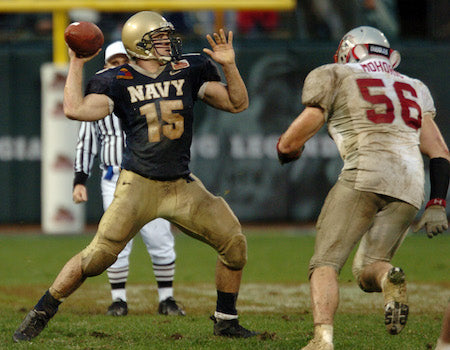
A Quarterback about to make a forward pass (source: Wikipedia)
Benjamin Russell Junior complained a lot about the American Football team uniforms, which at the time were very uncomfortable to wear.

Discover NASA Accessories →
Made of wool, these sports outfits caused heavy sweating and severe itching.

American Football uniform made of wool in the 1920s (source: Sports Memorabilia Museum)

Woolen outfits of the Michigan Wolverines team (source: Wikipedia)
With his father, they worked on a new uniform made of woven cotton in Jersey knit, from underwear already manufactured by the company.
The cotton provided greater comfort in terms of softness, and the Jersey knit offered flexibility to the jersey.
A manufacturing process dating back to the Middle Ages and originating from the island of Jersey in England (hence its name), the fabric is knitted, not "woven". It is a "fine" single-thickness knit, unlike Interlock Jersey which is double-thickness because it is knitted with two threads instead of just one.
Thick knits are those made of wool or any other knit with thick threads.
Jersey is recognizable because, like other knits, it has a right side and a wrong side.
On the right side, the stitches are V-shaped, while on the wrong side they form U-shaped waves.
Moreover, Jersey has the particularity that it does not fray!!
The Sweatshirt (or simply called "Sweat" in France) was born.
But that's not all: inside the Sweatshirt there is a fleece effect with loops called "loopback" which not only offers great comfort but also helps absorb sweat.
Sweat meaning "perspiration", "Sweat-Shirt" can be translated as "jersey for sweating".

"Loopback" loops used on the reverse side of the Sweatshirt (source: Pinterest)
On the front of the Sweatshirt, a triangle called "V-Stitch" was added, which serves a purpose similar to a sponge.
This helps optimize perspiration from the neck and centralize it to a single spot, thereby reducing the overly "wet" appearance.
But it also has another function: to reinforce the garment. Indeed, it helps to reduce collar deformation when it is pulled by an opposing player, for example.

The V-Stitch on the front of the Sweat Shirt (source: Nasa-Shop.fr)
Discover Men's Sweatshirts →
Another evolution in knitting: combed cotton.
Cotton fibers undergo a mechanical combing operation to lengthen them and make the fabric softer and more pleasant to wear. This ensures consistency in quality and comfort.
The combing method has also evolved to offer an even softer, more durable, and more resistant fabric. This is what is called RingSpun combed cotton (or Ring-Spun).
The quality is refined by eliminating shorter fibers, which can irritate the skin. The fabric is smoother than classic combed cotton and is even more comfortable to wear.
As you can see, it is therefore a sports garment designed for sweating and conducive to weight loss when worn during physical exercise.
But this garment has evolved greatly, both in its form and in its use outside of sports exercise.
The Hoodie or Hooded Sweatshirt
The well-known brand Champion invented the hooded sweatshirt, commonly known as a "Hoodie," in the 1930s.
First offered to New York warehouse workers who worked in very cold winter temperatures, it was later adopted for athletic but also cultural purposes.
It is a garment to be pulled over the head with kangaroo pockets.

Classic hooded sweatshirt or hoodie with kangaroo pockets (source: Nasa-Shop.fr)
Discover this sweatshirt →
Later came the Hoodie with a zipper (or zip-up).

Zip-up Hoodie with kangaroo pockets (source: Nasa-Shop.fr)
Discover this hoodie →
Evolution of the Sweatshirt
Subsequently, other variations appeared, such as the Sweatshirt without the V-Stitch with a classic round neck, the Sweatshirt with side pockets at the side seams, the Sweatshirt with a V-neck, and the Sleeveless Sweatshirt or cardigan.
Raglan sleeves
These are sleeves that extend up to the neckline, unlike classic sleeves which are sewn at the shoulders, giving a different and more aesthetic look.

Raglan sleeve sweatshirt available in our store (source: Nasa-Shop.fr)
Discover →
Modern Use
It was also the Champion brand that began supplying American university sports teams in the 1930s.
In 1937, inventor William Frederick Feinbloom (source: Wikipedia) filed a patent for a new flocking process on behalf of the Champion brand.
From then on, the Sweatshirt was used to proudly display affiliation with a university team and became the preferred casual garment for students.

Patent for the new flocking process by Champion (source: Google Patents)
Because it was a cheap way to disseminate information, advertisers began to use it for commercial purposes.
Since then, along with the T-shirt, it has become an essential medium for displaying all sorts of slogans or simple designs.
Easy to customize, the Sweat Shirt has become a vehicle for personal or commercial expression for the person wearing it.
It is used by universities, sports teams, and even businesses to identify with them.

Example of an academic Sweatshirt (source: Nasa-shop.fr)
Discover this Sweatshirt →
The Sweatshirt subsequently fell victim to its own success when the hip-hop movement that developed in New York adopted it. It thus became an integral part of this culture.
It was later used by surfers and skaters, which led to its worldwide dissemination in these two sports domains.
Given the scale of this boom, major fashion brands also jumped on the bandwagon and offered Sweatshirts and Hoodies in their collections from the 1990s onwards.
A large number of "streetwear" brands emerged under the influence of this now very popular garment.
The finishes
Certain things will differentiate a quality Sweatshirt from a low-end Sweatshirt:
✔︎ Ribbing (collar, sleeves, and waist)
Ribbing is a stretchy knit used for finishing the collar, sleeves, and waist.
✔︎ Straight and regular seams
✔︎ A fabric with a regular knit
✔︎ Good elasticity
Its elasticity is achieved thanks to its often tubular design characterized by a specific thread orientation, which helps reduce its deformation over time.

The finish is essential for the quality of your Sweatshirt
How to wear a Sweatshirt?
Originally created for "sportswear", it remains a very versatile garment that can adapt to all styles depending on its shape, color, or chosen graphic design.
Whether for a sports activity or for lounging at home, worn casually, "casual" or with elegance, classic or modern, there are a thousand ways to wear a Sweatshirt today.
Wearing a Sweatshirt with a cap is also very fashionable...

Discover NASA headwear →
In summary
The Sweat Shirt has become a "basic", meaning a garment that has become indispensable in a wardrobe because it goes with everything and can stand the test of time.
It's a timeless garment that can be worn until it wears out and in all circumstances. You can pair it with a Baseball cap for an incomparable and trendy look.
Louise from the NASA SHOP France team